
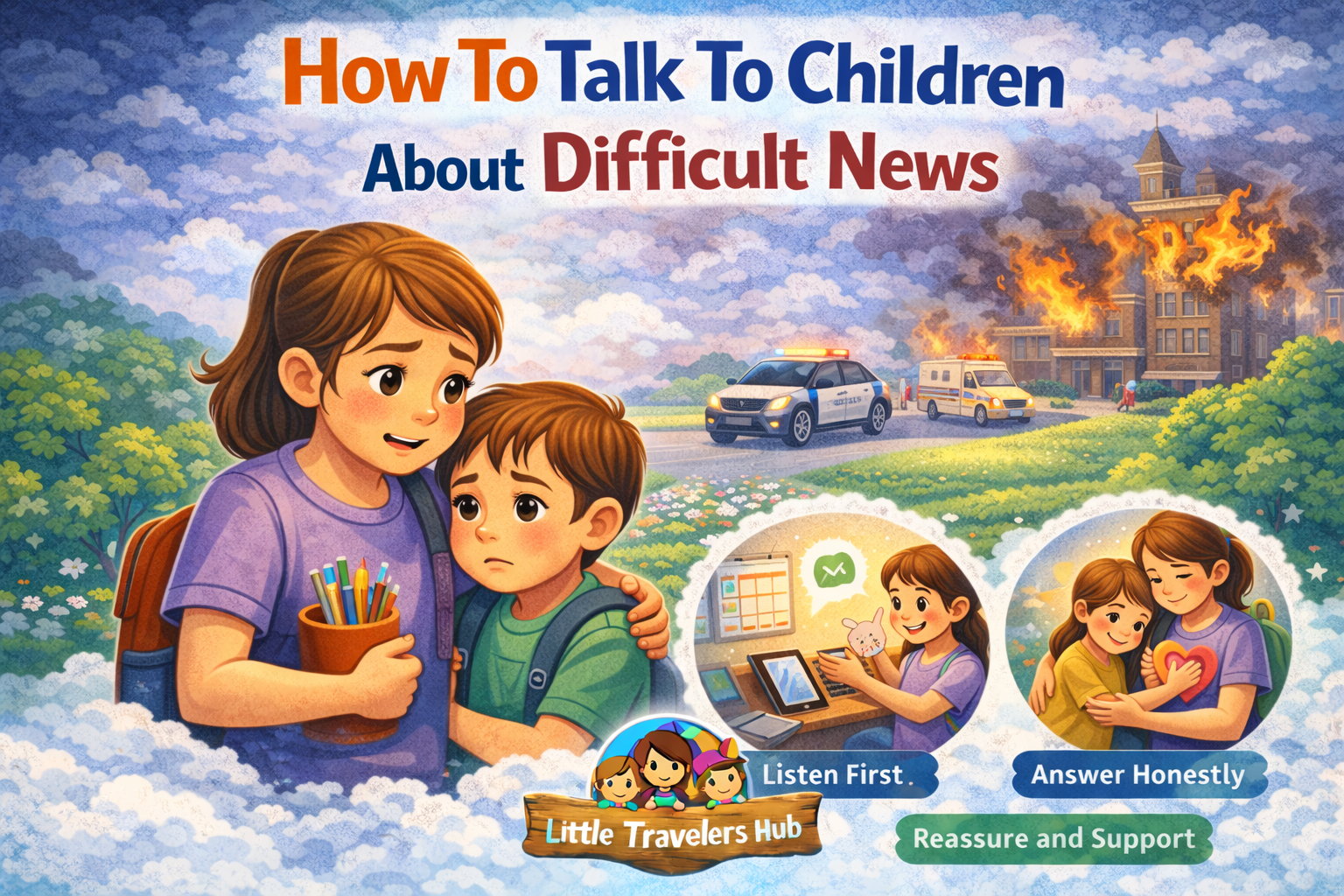
How To Talk To Children About Difficult News
Children are sensitive, not physically but mentally as well. A small bad news can affect them hard. So think twice while talking about any bad or difficult news in front of them. The teachers and the parents try to be normal while talking about tough news. But, there is another case, the kids must know what bad things are happening around them so that they can protect themselves and not get trapped. The violence, tragedies and dangers are all around us. So it is better to make things in their knowledge with a normal but emphasizing tone.
The task is challenging, but taking a proactive stance, discussing the difficult events in an age appropriate language can secure your child. It is a psychological factor that if the adults try to hide something from the children they would want to know what’s happening. So, if you don’t talk about that, they may underestimate or misunderstand the event. It is better to initialise yourself, it will give confidence and self esteem to our kid that how supportive and good a listener you are.
Talking to children about difficult news requires honesty, empathy, and age-appropriate language. Children often sense when something is wrong, so avoiding the topic can increase fear and confusion. Start by asking what they already know, listen carefully to their feelings, and provide simple, factual explanations without overwhelming details. Reassure them about their safety, validate their emotions, and let them know it’s okay to ask questions now or later. Most importantly, stay calm—your tone and reactions help children feel secure while processing challenging information.
Helpful Approaches When Discussing Difficult News
| Situation | What Children May Feel | Helpful Parent Response |
|---|---|---|
| Hearing upsetting news | Fear or confusion | Explain calmly in simple terms |
| Exposure to media | Anxiety or worry | Limit news exposure |
| Asking repeated questions | Need for reassurance | Answer patiently and consistently |
| Emotional reactions | Sadness or anger | Validate their feelings |
| Silence or withdrawal | Overwhelm | Encourage gentle conversation |
| Misunderstanding facts | Increased fear | Correct gently and clearly |
How To Talk?
- Prepare Yourself First
You must be ready before initializing a conversation about what you are going to say. If you fumble, you can not carry on the entire conversation properly and efficiently. If not, then there is no use of talking about a serious topic. Practice in mind what language you should use according to your kid’s age, or practice in the mirror. Some advance planning can make the conversation easy and smooth.
- Find a Silent Place
The sensitive topics need proper time to talk about. It can not happen while watching TV, playing cards or doing something entertaining. You need the full attention of children to start a conversation. In my opinion, the time after dinner or while making the next day’s lunch, you can do it. In that situation, you can judge from their expression how they are getting it. Walking is another option to discuss serious topics.
- Try To Know, What They Know
In this world of the internet, where everything is just one click away, you can’t deny that children learn more from Google instead of their books. However, start a conversation to judge whether your child knows already about it or not. You can ask a question like, there is a bomb placed in a country or the parents are looking for their kid who didn’t get back to home. Have you heard or read anything about this? Let them answer, and just listen, listen, listen.
- Share Your Emotions
We agree that you are adults, you are parents. You must be responsible, perfect and mature enough in front of your kids. Only then you would be a role model. Wait, you are humans as well, your children would respect your thoughts and emotion if you open yourself up. Pull yourself together and can continue by giving your example. Try this, both will be easy and you must have smooth and deep talks.
- Be Realistic, Don’t Lie
What would you get by telling a lie? There is no need for that conversation where you don’t want your child to face reality. Be realistic and lay out the facts where they can understand easily. Don’t exaggerate heavy details.
While talking about death with the young children, you may have to be normal in tone like the dead people can’t eat anything, we don’t see them again, they are not thirsty, they no longer feel anything, scared or hurt anymore, but we can save their memories and pray for them in our heart.
Sometimes, your child may be stuck somewhere which you don’t or can’t answer, it is better to say “ I don’t Know “. like “ Why did this happen to us? “, “ Why did God let it happen? Answer these questions in simple “ I don’t know “.
- Reassure Them
Children would love it when you reassure them, tell them you are there for them in any situation. They can talk to you if anything happens to them or they are doubted about something, they can openly come to you. Tell them, you, as a parent, know how to protect them and teach them what’s right or wrong for them. When you close the conversation here, your child will be free minded and mentally easy.
- Take Care Of Yourself Too
While taking care of a small one’s mental health, take good care of yourself too. You sometimes have to share personal experiences that are heart wrenching and exhausting, at that time you need to take care of yourself. What can you do is: break the news, change the topic, indulge yourself in a physical activity, or start talking about what gives you warmth and spirit.
- Seek Professional Help
The above discussion is about stabling a child’s mental health. If you see positive changes in them, it is very good. But, if there is something you can not handle, and our child is getting stressed day by day. It is better to ask for a professional help. A licensed mental health professional will assist you in developing an appropriate strategy for moving forward
It is concluded that a child’s mental health would be stable only if you are a good listener and an understanding parent. Let them open up in front of you, you must find out something that is bothering your small one.
Takeaways Section
Key Takeaways for Talking to Children About Difficult News
- Children need honesty delivered in age-appropriate language
- Listening is just as important as explaining
- Reassurance helps children feel safe
- Limiting media exposure reduces anxiety
- Calm responses build emotional security
- Ongoing conversations matter more than one talk
FAQs
FAQ 1: Should I tell my child about difficult news at all?
Yes. If children are aware something is happening, honest and gentle explanations help prevent fear and confusion.
FAQ 2: How much detail should I share?
Share only what your child needs to understand, based on their age and emotional maturity.
FAQ 3: What if my child becomes very upset?
Stay calm, comfort them, and let them express their emotions without rushing to “fix” them.
FAQ 4: Is it okay to say I don’t know the answer?
Absolutely. Saying “I don’t know” builds trust and shows honesty.
FAQ 5: How can I reduce my child’s anxiety after the conversation?
Reassure them of their safety, keep routines stable, and limit exposure to distressing media.
FAQ 6: Should I revisit the topic later?
Yes. Children may need multiple conversations as they process information over time.